
Table of Contents
- Understanding Abuja’s Layout Before You Book
- Central Business District: Built for Meetings
- Maitama: Abuja’s Diplomatic and High-Security Zone
- Asokoro: Quiet Streets Near Embassy Row
- Wuse II: The Commercial Hub With Energy
- Gated Estates vs. Standalone Buildings: What Actually Matters for Security
- Where to Stay in Abuja: Which Neighborhood Fits Your Trip?
- FAQ
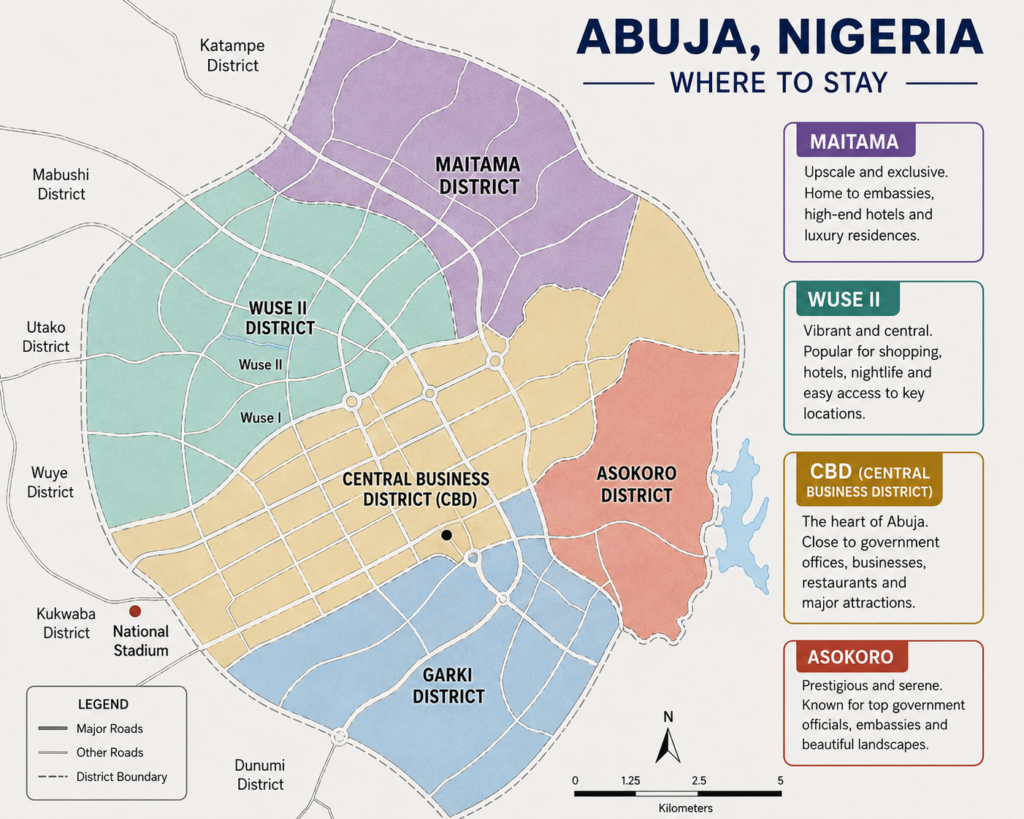
Figuring out where to stay in Abuja is really a question of who you are as a traveler, not just which hotel has the best photos online. A diplomat, a contractor on a two-week project, and a family visiting relatives will all be happiest in different parts of the city. This guide breaks down Abuja’s main hospitality districts, the Central Business District, Maitama, Asokoro, and Wuse II, and explains what kind of trip each one suits.
We’ll also look at gated estates versus standalone buildings, since that distinction often matters more for day-to-day security and quiet than the neighborhood name alone.
Understanding Abuja’s Layout Before You Book
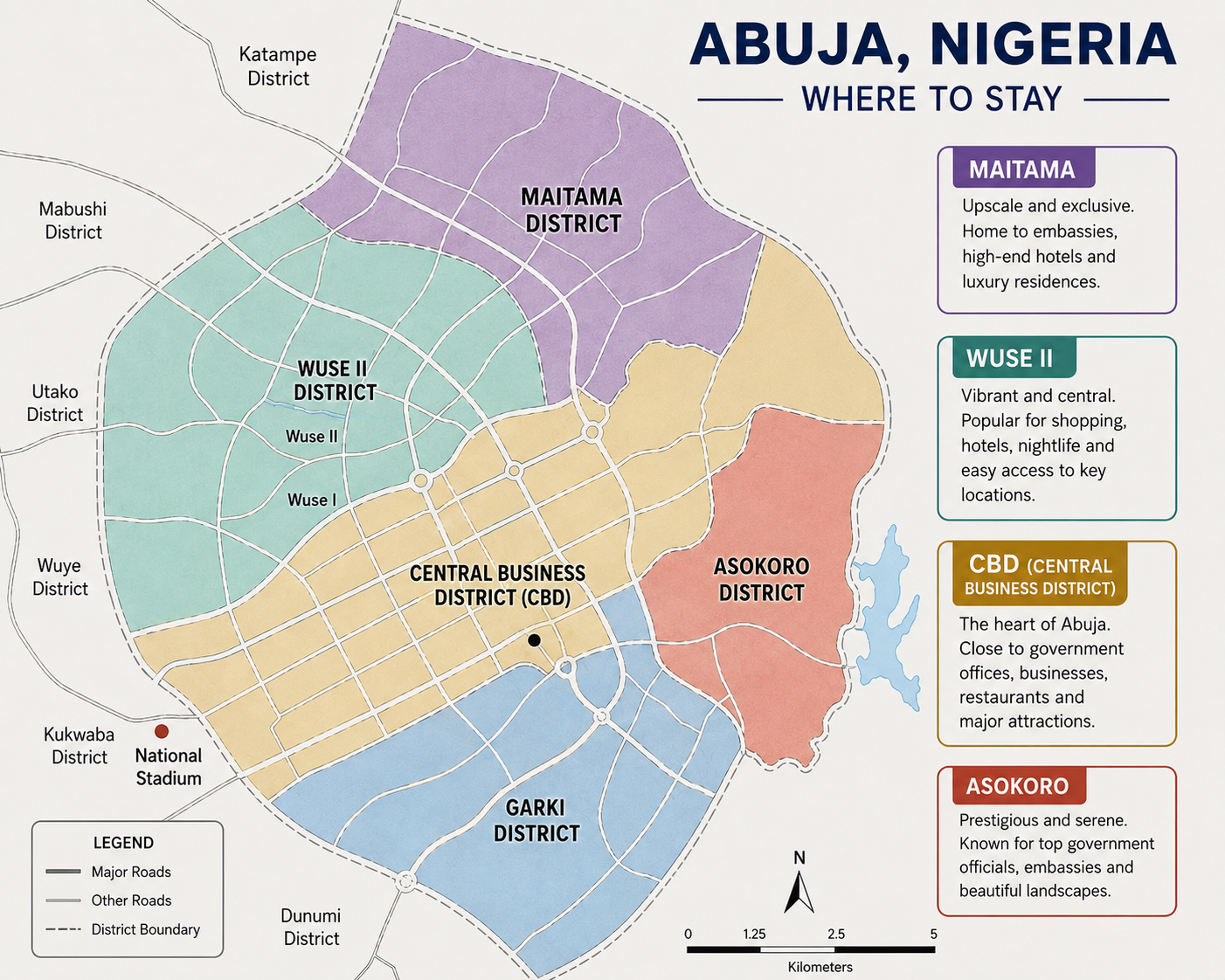
Abuja was built as a planned capital, and that planning shows up in how the districts are organized. The city center — the Central Business District, sits at the middle, with residential and diplomatic zones like Maitama and Asokoro spreading out from it. Wuse and Wuse II sit closer to the commercial and retail action.
This layout matters when you’re deciding where to stay in Abuja, because distance from your meetings, your embassy appointment, or the airport road can add real time to your day. w
my[VERIFY: current typical drive times between these districts and the Nnamdi Azikiwe International Airport].
Most first-time visitors ask the same question: which district is actually safest? The honest answer is that safety depends on the specific street and property, not just the district name. Still, some general patterns hold, and they’re useful when you’re narrowing down where to stay in Abuja for the first time.
Central Business District: Built for Meetings
The Central Business District, or CBD, is where much of Abuja’s corporate and government activity happens. If your trip is packed with meetings at ministries, banks, or head offices, staying here cuts down on daily commute time.
The CBD tends to be busier and more commercial in feel than Maitama or Asokoro. Traffic can build up during the working day, and the area is less residential at night. It’s a practical short let Abuja option for travelers whose whole schedule revolves around the city center, but it’s not the quietest choice if you want a residential feel after hours.
Best for: short business trips, single-city-center meetings, travelers without a rental car.
If you’re only in the city for a day or two of back-to-back meetings, the CBD is usually the simplest answer to where to stay in Abuja. It’s a straightforward pick, and it keeps where to stay in Abuja simple for very short trips.
Maitama: Abuja’s Diplomatic and High-Security Zone
Maitama is one of Abuja’s original high-income districts and is home to a large number of embassies, consulates, and diplomatic residences. Because of that concentration of diplomatic missions, the area generally carries a visible security presence, well-maintained roads, and a quieter residential atmosphere than the CBD or Wuse II.
This makes Maitama a common choice for diplomats, NGO staff, and corporate travelers who want a calm base with easy access to embassies and government offices. Luxury suites Abuja travelers frequently look at Maitama first, since the area’s serviced apartments and boutique hotels tend to match the neighborhood’s upmarket profile.
Best for: diplomatic visits, longer corporate postings, travelers prioritizing quiet over nightlife.
Travelers comparing where to stay in Abuja for an embassy-related trip often start their search in Maitama for exactly this reason.
Asokoro: Quiet Streets Near Embassy Row
Asokoro sits close to Maitama in character. It’s another long-established diplomatic and high-income district, known for wide streets, embassy compounds, and a low-density residential layout. Many senior government officials and diplomats live in Asokoro, which contributes to a steady, low-key security presence in the area.
For travelers who want the diplomatic-zone calm of Maitama but a slightly different residential feel, Asokoro is worth comparing directly. Lisa Suites is based in Asokoro, offering serviced apartments Abuja travelers can use as a quiet, private base close to embassy row. You can view available rooms and suites to see current layouts and availability.
Best for: longer stays, families, travelers who want privacy and low noise.
For many travelers, Asokoro answers the where to stay in Abuja question simply by being close to embassy row while still feeling residential.
Wuse II: The Commercial Hub With Energy
Wuse II is one of Abuja’s busiest commercial districts, packed with restaurants, shopping, banks, and offices. It has a livelier, more urban feel than Maitama or Asokoro, with more foot traffic and more going on after dark.
If your trip involves running errands, meeting clients across different offices, or simply wanting restaurants and shops within walking distance, Wuse II is a strong fit. It’s generally busier and more exposed to street-level activity than the diplomatic districts, which is a tradeoff worth weighing if quiet is your priority.
Best for: travelers who want walkable amenities, shorter city-based trips, younger business travelers.
For travelers weighing where to stay in Abuja against a tight schedule of errands and client meetings, Wuse II’s density of shops and offices is a real advantage.
Gated Estates vs. Standalone Buildings: What Actually Matters for Security
Neighborhood reputation is only part of the security picture. Within any district, a property inside a gated estate typically has an additional layer of access control, a shared perimeter, a gate, and often shared security staff — on top of whatever the building itself provides.
A standalone building on a public street, even in a well-regarded neighborhood, relies more heavily on its own gate, staff, and cameras. Neither setup is automatically better in every case, but the difference is worth asking about directly when you book.
When comparing options, ask specifically about:
- Whether the property sits inside a gated estate or on an open street
- What security staffing looks like at night versus during the day
- Whether visitors are logged or announced before entering
- How the property handles deliveries and service staff access
- Where to Stay in Abuja:
[VERIFY: specific security features and staffing details for Lisa Suites’ Asokoro property].
This is really the second layer of the where to stay in Abuja question: after you’ve picked a district, look at the property itself with the same level of attention.
Where to Stay in Abuja: Which Neighborhood Fits Your Trip?
| District | Character | Best For | Noise Level |
|---|---|---|---|
| Central Business District | Corporate, dense | Meeting-heavy short trips | High during the day |
| Maitama | Diplomatic, upmarket | Embassy visits, quiet stays | Low |
| Asokoro | Diplomatic, residential | Longer stays, families, privacy | Low |
| Wuse II | Commercial, lively | Walkable errands and dining | Moderate to high |
[VERIFY: distance in kilometers or typical drive time from each district to the airport and to the CBD].
If you’re still weighing where to stay in Abuja, the short version is this: pick the CBD for convenience to meetings, Maitama or Asokoro for quiet and diplomatic-zone security, and Wuse II for energy and walkable amenities.
There’s no single correct answer to where to stay in Abuja, the right district changes with the purpose of the trip, and the table above is meant as a starting point rather than a final rule.
FAQ
These are the questions travelers ask most often when they’re still deciding where to stay in Abuja.
Is Asokoro a safe area to stay in Abuja? Asokoro is widely known as one of Abuja’s diplomatic districts, with a large number of embassy residences and government officials living in the area, which generally supports a visible, steady security presence. [VERIFY: any specific, sourced safety statistics for Asokoro].
What’s the difference between Maitama and Asokoro? Both are established diplomatic and high-income districts with quiet, low-density streets. The two are often compared directly by travelers, and the practical differences usually come down to specific embassy locations, property age, and individual estate security rather than one district being broadly safer than the other.
Is Wuse II good for a short let in Abuja? Wuse II works well for short lets when your trip involves errands, dining, or meetings spread across the commercial district, since amenities are close by. It’s busier and less residential than Maitama or Asokoro.
Does staying in a gated estate matter more than the neighborhood? Both matter. A good neighborhood reputation doesn’t replace property-level security, and a well-secured building in a busier district can still feel safer day-to-day than an exposed property in a quiet one. Ask about gate access and night staffing directly.
How do I decide where to stay in Abuja if I’ve never visited before? Start with your itinerary. If most of your time is spent at ministries or head offices, the CBD saves commute time. If you value quiet and diplomatic-zone security, compare Maitama and Asokoro directly these are. If you want restaurants and shops within walking distance, Wuse II fits better.
Where is Lisa Suites located? Lisa Suites is located in Asokoro. You can view available rooms and suites for current details.
For broader context on how Abuja’s districts were planned and developed, the Federal Capital Territory Administration publishes information on the city’s official district structure and development.


Super convenient for local users. The registration was a breeze and the customer support team is very responsive. Great job on the platform. phpeso123